Outreach that gets reviewed
Link building outreach that publishers can actually review.
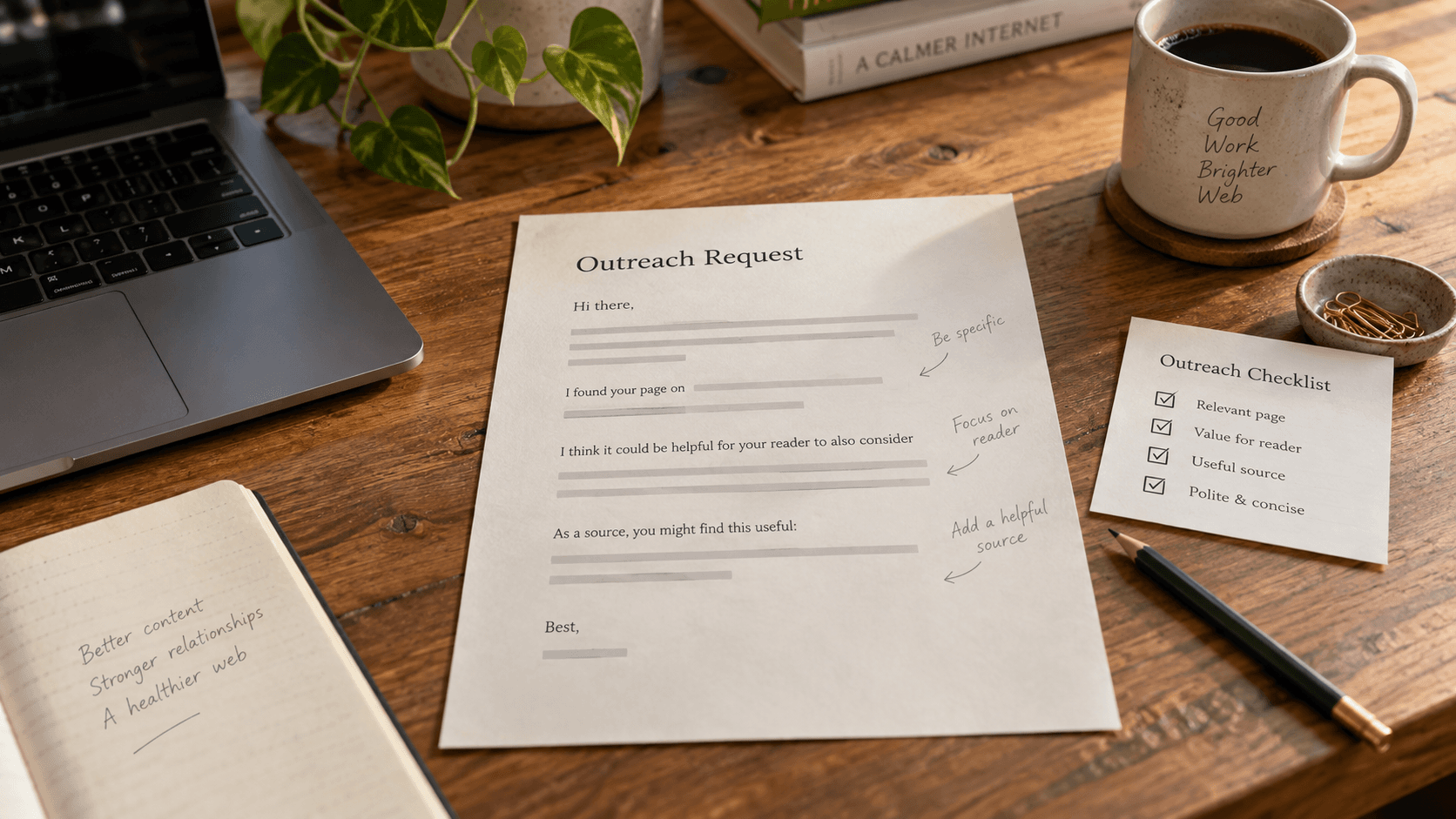
The strongest outreach request is not the one that asks for a backlink most clearly. It is the one that helps a publisher see a useful page, a real reader benefit, and a contribution worth evaluating in under a minute.
The short version
Start with an editorial reason, not a link request.
A publisher is deciding whether your suggestion improves a page. Give them the exact page, shared audience, missing value, source, and permission to say no. The link is a possible result of that decision—not the whole pitch.
Find better pages before outreachA reviewable request
“I read this exact page, noticed this reader gap, and can offer this useful source. Please use it only if it improves the page.”
That framing protects the publisher's editorial control while making your own contribution easy to evaluate.
Before you write
Fill in the publisher review card.
Do this research before opening an email draft. If you cannot answer these fields, the opportunity is probably not ready.
The page
Name the exact URL and the section you read. A publisher should not have to search for the context.
The shared reader
Explain who benefits from both resources and what they are trying to do right now.
The missing value
Point to the example, evidence, definition, or workflow that would make the page more complete.
Your contribution
Offer something specific you can provide: a first-party example, data point, screenshot, quote, or draft.
The placement idea
Suggest a natural place without demanding an anchor text, position, or dofollow treatment.
Editorial freedom
Make it easy to edit, qualify, move, or decline the suggestion. The publisher owns the decision.
Five outreach templates
Choose the situation, then keep the note human.
These are starting points, not mail-merge copy. Replace every bracket with evidence from the page you actually reviewed.
Resource page mention
Use this when a maintained resource page already helps the same audience and your guide fills a visible gap.
Subject: A practical source for your [topic] resource page

Hi [name],

I was using your [resource page] while researching [specific reader task]. The section on [section] is especially useful because [specific reason].

One gap I noticed: readers who need [missing step] may also benefit from [your resource], which includes [original evidence or workflow]. If you think it improves the page, here is the source: [URL].

No worries if it is not a fit. Thanks for maintaining such a useful resource.

Best,
[name]Product roundup
Use this when the roundup has clear inclusion criteria and your product genuinely meets them.
Subject: Possible addition for your [category] roundup

Hi [name],

Your [roundup] is a helpful starting point for [audience]. I noticed the current list focuses on [pattern], while readers who need [use case] may also be looking for [capability].

[Product] is built for [specific audience] and is different because [verifiable distinction]. If it meets your criteria, the product page is here: [URL]. Please use your own wording and include it only if it helps readers.

Thanks for the careful curation,
[name]Founder example or case study
Use this when the publisher tells stories about a problem your team has actually solved.
Subject: First-party example for your [topic] article

Hi [name],

I enjoyed your section on [specific idea] in [article]. We ran into the same problem while [context] and learned [useful lesson].

If you ever update the piece, I can share a short first-party example with [metric, method, or artifact] and answer questions about the trade-offs. Here is a public starting point: [URL].

It is completely fine if the story is not right for this article. I wanted to offer a source that matches the problem you are explaining.

Best,
[name]Guest contribution
Use this only when the publisher openly accepts expert contributions and you can bring original work—not a thin article with a link inserted.
Subject: Contribution idea for [publication]

Hi [name],

I saw that [publication] covers [specific theme] with a practical, operator-led angle. I would like to propose [working title], a [format] based on [original experience, research, or dataset].

The reader would leave with [three concrete takeaways]. I can provide [outline, screenshots, data, or examples], follow your editorial process, and keep any relevant product mention factual and optional.

Would that fit a current gap in your calendar? A quick no is useful too.

Best,
[name]Integration or partnership
Use this when two products already serve the same workflow and a shared guide, integration, or customer resource would help both audiences.
Subject: A useful [integration/workflow] for our shared audience

Hi [name],

Our customers use [your product] and [their product] together for [workflow]. We noticed that the current explanation of [problem] leaves out [specific step].

Would you be open to a short co-authored guide, integration note, or customer example? We can bring [contribution], review facts together, and let each team choose the most useful public destination. There is no link requirement; the goal is a resource customers can actually use.

If it is not on your roadmap, no problem.

Best,
[name]
The quality test
A publisher should be able to say “why this page?” immediately.
If the request could be sent to 200 unrelated domains with only the name swapped, it is not qualified yet.
Hard to review
“Great site. Please add our link to your homepage. We can exchange links and use this exact anchor.”
Easy to review
“In your section on [task], readers may need [missing step]. Our first-party example covers it. Use it only if it improves the page.”
After you send
Follow up with restraint.
A good request respects the publisher's queue. Your follow-up should reduce uncertainty, not manufacture urgency.
Wait at least five to seven business days so a real publisher has time to review the page.
Send one short follow-up that adds context or an answer; do not forward the same pitch with more urgency.
Stop after one follow-up. Silence is a decision, not an invitation to escalate across channels.
Do not turn a declined editorial suggestion into a reciprocal-link demand or a paid-placement conversation.
Publisher review card
Run this checklist before you press send.
Is the exact page maintained and clearly intended for a real audience?
Can I describe the reader problem in one sentence?
Does my contribution add something the page does not already explain?
Can I support the claim with a public source or first-party evidence?
Would the mention still make sense if it carried no ranking credit?
Am I giving the publisher control over wording, placement, and whether to publish?
Have I made the request short enough to review on a busy day?
Is this a relationship I would be comfortable continuing without a link?
Where Indie Chains fits
Keep discovery structured; keep publication editorial.
Indie Chains helps founders find reviewed sites, inspect audience and topic context, and start a focused private conversation. A site owner still decides whether a suggestion belongs, how it is worded, and whether it should be published.
Free publishers can list compliant sites, receive inbound requests, and manage accepted collaborations. Premium adds private site discovery and limited outbound requests. Membership does not buy a placement, a dofollow link, or a ranking outcome.
Frequently asked questions
Questions founders ask before outreach.
How long should a link building outreach email be?
Aim for roughly 100 to 180 words: enough to name the page, shared reader, missing value, and source. If the publisher has to decode a long background story before finding the request, shorten it.
Should I mention Domain Rating in an outreach request?
Usually no. Domain Rating is a third-party metric, not a reader benefit or editorial reason. Lead with the page, audience, and contribution; use authority metrics privately as one qualification signal.
How many times should I follow up?
One thoughtful follow-up is enough. Add useful context, wait five to seven business days, and stop if there is no response. Repeated nudges make a relevant request feel like a quota.
Should I offer a reciprocal link?
Do not make a reciprocal link a condition of the request. Relevant sites may naturally mention each other over time, but a link-for-link requirement removes editorial independence and can create spam risk.
Can I do link building outreach without cold email?
Yes. Start with customers, partners, communities, product integrations, contributor programs, and existing unlinked mentions. A warm context usually produces a better editorial reason than a larger cold list.
Make the next request useful
Find a relevant page, then start a conversation worth having.
Use the review card to qualify the opportunity, and keep the publisher in control from the first message to the final placement.