Recover recognition you already earned
Link Reclamation: How to Recover Lost Backlinks and Unlinked Mentions
A founder-friendly workflow for repairing links, mentions, destinations, and attribution you already earned without turning every issue into a new outreach campaign.
The short answer
Link reclamation is the repair work that follows recognition you already earned.
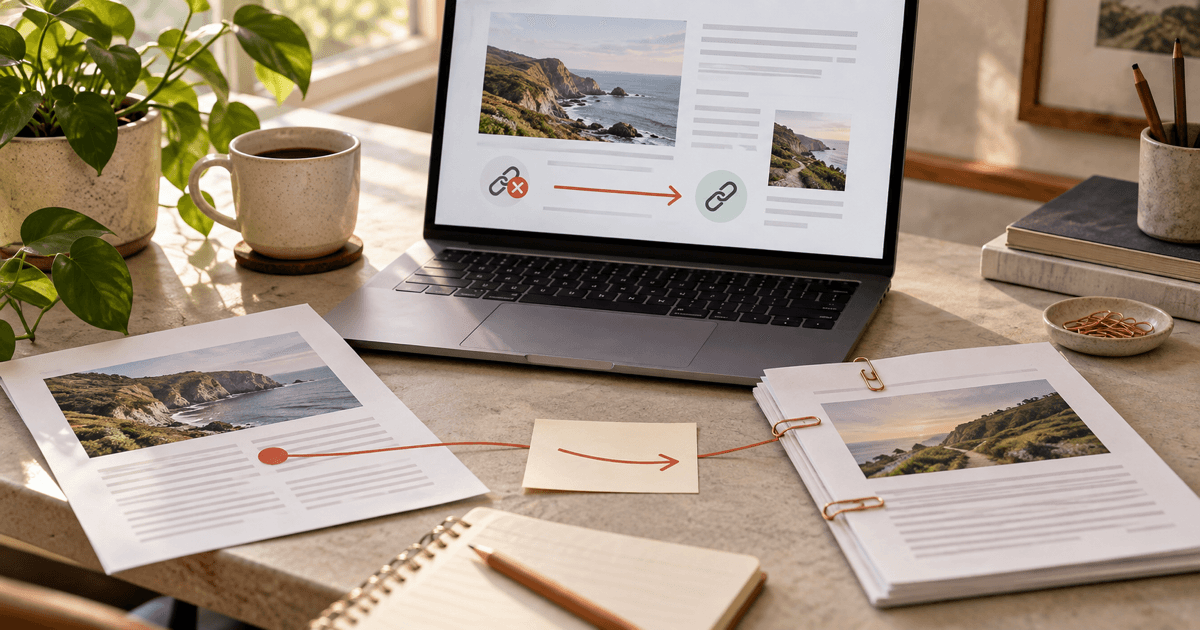
Find mentions and links that were removed, broken, misdirected, or never linked. Fix the destination or redirect you control, then contact a publisher only when a precise correction would help readers. It is not an entitlement to a link, a demand for a particular anchor, or a promise of ranking value.
Start with the boundary
This guide begins after someone has already recognized your product, research, image, data, or company. It is about the link that changed, the URL that broke, or the mention that never became a useful reference. The broader backlinks without cold outreach playbook covers ways to earn new attention through assets, communities, launches, and relationships.
Do not begin by asking for a link. Begin by asking what a reader sees today, what the publisher intended, and whether you can improve the path without taking editorial control away from them.
Seven situations that look like reclamation
These situations need different responses. A missing href is not the same problem as a broken destination, and an unlinked mention may be perfectly reasonable editorially.
| Situation | What it means | First response |
|---|---|---|
| Lost backlink | A source page used to link to you, but the expected href is no longer present. | Recheck the exact page, save the last confirmed state, and contact the publisher only when the page still matters. |
| Broken destination | The source still links to a URL that returns an error or no longer serves the intended resource. | Restore the destination or publish an equivalent replacement before deciding whether the publisher needs a note. |
| Redirected URL | The source or destination now redirects, and the final page may or may not be an equivalent reader path. | Follow the chain. Keep an equivalent migration, repair your own redirect, or ask for a precise update if the reader task changed. |
| Unlinked brand mention | A publisher names your company, product, research, or founder without a hyperlink. | Treat the mention as recognition, not an entitlement. Ask only when a link would help the reader verify or use the referenced thing. |
| Uncredited image or data | A page uses an image, chart, dataset, or finding you created without clear attribution. | Confirm ownership and the original source. Request factual attribution when it improves provenance or satisfies a real licensing need. |
| Incorrect destination | A link exists but points to the wrong product, an old homepage, a tracking URL, or a page that does not answer the sentence. | Fix the destination you control first. If the source needs an edit, suggest the smallest reader-facing correction. |
| Changed product or company name | The old name remains in a title, link, image, or factual description after a rebrand or product change. | Create a useful replacement path, then contact the publisher only when the old wording is materially misleading or the correction is easy to verify. |
A 30-minute founder workflow
Set a timer and work on one asset or one small set of related pages. The goal is a trustworthy next action, not a perfect inventory.
0 to 5 minutes: define the baseline
Choose one site, product, report, launch, or rebrand. Write down the URLs, old and current names, original asset locations, and the date each placement or mention was last confirmed. Start with the exact source page, not only a referring domain.
5 to 10 minutes: collect signals
Use the Search Console Links report for a sampled Google view, analytics for observed referral visits, brand and product searches for new mentions, and a backlink tool for historical or lost-link leads. Each source is incomplete. A tool alert is a lead, not proof that a publisher changed a page.
10 to 18 minutes: verify the page
Open the source URL. Record its HTTP status and redirect chain, search for the expected href, inspect the anchor and nearby sentence, follow the destination, and note canonical, robots, rel, ownership, and the last successful check. If access is blocked, record unknown instead of guessing.
18 to 24 minutes: score the opportunity
Use the matrix below. Give more attention to pages that are relevant, send real readers, are easy for you to fix, have a reasonable relationship path, and would genuinely improve the publisher’s page. The score organizes a queue; it does not forecast rankings.
24 to 30 minutes: choose one proportionate action
Fix your own URL, create a redirect, prepare one short publisher note, or ignore the opportunity. Save the evidence and the reason. A clean decision to leave an editorial choice alone is a successful outcome.
Search Console’s Links report is a sampled view, not a complete list. Analytics records what your setup observed, brand searches find only what is discoverable, and third-party backlink tools report what their crawlers found. Keep each signal labelled as observed, unavailable, or inferred.
Prioritize what can actually be finished
Rate each opportunity from low to high across these five factors. You can use 0, 1, or 2 as a simple queue score, but do not turn the total into a ranking forecast.
| Factor | High priority | Low priority | Evidence to use |
|---|---|---|---|
| Page relevance | The source page answers a problem your product, research, or resource directly supports. | The mention is adjacent but the reader connection is difficult to explain. | Read the exact section. Do not use domain-level relevance as a substitute. |
| Real referral traffic | Analytics shows visits or qualified actions from the source, with a clear observation date. | No traffic is observed, or the source cannot be separated from other referrals. | Treat analytics as business context, not proof of ranking impact or causation. |
| Fix complexity | You can restore the destination, update the redirect, or provide one exact correction quickly. | The fix needs a large migration, legal review, or work the publisher cannot reasonably do. | Prefer fixes you control. Complexity is a queue signal, not a reason to pressure an editor. |
| Relationship strength | You know the publisher, contributor, customer, partner, or editor and can write with context. | There is no relationship and the request would create a new conversation from scratch. | A weak relationship does not make a request wrong, but it raises the bar for specificity and restraint. |
| Editorial value | The correction makes the page more accurate, useful, verifiable, or easier for its readers to use. | The only benefit is an extra link or anchor for your own acquisition goals. | If the publisher would not reasonably choose the edit for readers, ignore it. |
A relevant mention with real referral visits and a broken URL you control is usually a better first fix than a prestigious but unrelated page with no reader path. This is an operational judgment about usefulness and effort, not a claim that a domain metric or traffic observation determines rankings.
The decision tree
Move from evidence to the smallest action that protects the reader’s path. The publisher remains free to edit, qualify, remove, or decline.
- Opportunity found? Verify the exact source page and save the current status, link, context, and destination.
- Can you fix the problem yourself? Restore the destination, publish the equivalent replacement, or add a clean redirect. Then recheck the source.
- Is the source relevant and still useful? If no, record the evidence and ignore it. If yes, continue.
- Would a correction help the publisher’s readers? If no, do not contact. If yes, send one short, optional, page-specific note.
- Did the publisher choose not to change it? Respect the decision, update your record, and close the opportunity.
When a redirect is better than outreach
If an old URL on your site moved to a closely equivalent page, a server-side redirect is often the cleanest first step. It repairs the destination for readers and removes the need to ask every publisher to edit an older article. Follow the final path and record the change.
Do not redirect an unrelated old page to your homepage merely to preserve a backlink. If there is no useful equivalent, a misleading destination is worse for the reader than an honest dead end. Google’s canonicalization guidance and the semantics in RFC 9110 are useful references when you document what changed, but neither turns a redirect into a promise of SEO value.
Four respectful templates
Use these only after you have verified the page and can name a reader-facing reason. Leave the publisher free to decline.
Broken destination
Hi [name], I was reading [exact page] and noticed the link to [resource] now returns [brief status or result]. I restored the equivalent page here: [URL]. If you are already updating the article and it still fits your context, this may be a useful replacement. If the change was intentional, no action is needed. Thanks for checking.
Unlinked factual mention
Hi [name], I appreciated the mention of [product, research, or company] in [exact page]. If readers would benefit from verifying that reference, our original source is here: [URL]. Please use it only if it makes the sentence more useful. I am happy for you to leave the mention unlinked if that is the better editorial choice.
Incorrect URL
Hi [name], I noticed the link in [exact page and section] currently points to [current URL], while the sentence appears to refer to [specific resource]. The closest current page is [URL]. If you decide to update it, that should take readers to the resource described. If the current link is intentional, please ignore this note.
Missing attribution
Hi [name], I noticed [image, chart, or data] from [exact page] appears in your article. I created the original source here: [URL], and the relevant attribution or license note is [brief evidence]. If you keep using the asset, would you consider adding that credit where readers can see it? If you would rather remove or replace it, that is completely fine.
When not to contact the publisher
- The page is irrelevant, automated, or built mainly to host outbound links.
- You cannot verify that a link or mention existed, and your only evidence is a tool alert.
- The publisher intentionally removed or changed the reference and the current page is still accurate.
- Your proposed edit would add promotion without improving the reader’s ability to understand or verify the claim.
- The page is inaccessible after reasonable checks and you would need to bypass a login, CAPTCHA, or access policy.
- The request would pressure the publisher for an exact-match anchor, a dofollow attribute, a reciprocal link, or a guaranteed outcome.
If the situation is genuinely a new editorial suggestion rather than a correction to recognition already earned, use the link-building outreach guide and give the publisher a clear reason to review it. Reclamation is narrower and more respectful when it stays tied to evidence.
A few realistic founder examples
A product migration
A founder moves a pricing calculator from /calculator to /tools/pricing-calculator. A partner guide still links to the old path. The founder adds a clean redirect, tests the final page, and records the fix. There is no need to ask the partner to edit an article unless the old wording or context is now wrong.
An unlinked research mention
A SaaS team publishes a small first-party benchmark. A newsletter names the benchmark but does not link to it. If the original methodology would help readers inspect the claim, a short optional note may be useful. If the sentence already stands on its own and the link would only serve acquisition, the team can leave the mention as recognition.
A rebrand with a factual correction
An indie product changes its name and keeps the old domain path redirecting to the current product page. An old directory listing still describes the former name as an active product. The founder can offer the current name and URL as a factual correction, but the directory remains free to update, keep, or remove the listing.
Where Indie Chains fits
Indie Chains does not currently promise automated reclamation, backlink crawling, lost-link alerts, or recovered placements. It helps founders discover reviewed sites and manage voluntary, context-first relationships. Use the backlink exchange platform for discovery, then inspect every page and preserve the publisher’s editorial control.
For a candidate you have not yet pursued, start with the backlink quality checklist. For prospect research, see how to find backlink opportunities. Reclamation begins later, when there is a real page, mention, destination, or attribution issue to verify.
Questions founders ask about link reclamation
What is link reclamation?
Link reclamation is the process of repairing or respectfully requesting corrections for recognition you already earned, such as a lost backlink, broken destination, redirected URL, unlinked mention, missing attribution, or outdated product name. It is not a right to a link and it is not a replacement for creating useful resources or building relationships.
How do I recover a lost backlink?
Verify the exact source page first, save evidence that the link is absent, and check whether your own destination or a site migration caused the problem. If the source is still relevant and the correction would help readers, send one short, optional note. Do not assume removal was accidental or promise a ranking outcome.
How can I find unlinked brand mentions?
Search for your company, product, founder name, old product name, research title, and distinctive phrases in search engines. Compare those results with analytics, Search Console, and a backlink tool. No single source finds every mention, so treat each result as a lead that needs page-level verification.
Should I contact a publisher for every lost link?
No. Contact a publisher only when the page is relevant, the change is verifiable, and a correction would improve the reader’s experience or factual accuracy. Do not contact an irrelevant, low-quality, intentionally edited, inaccessible, or clearly automated page just to recover a link.
When is a redirect better than outreach?
A redirect is usually the cleaner first move when a URL you control moved to a closely equivalent page. It restores the reader path without requiring an editor to update an old article. Do not redirect an unrelated URL to your homepage just to preserve a backlink.
Sources
Primary references for Search Console reporting, crawlable links, link attributes, canonicalization, robots directives, link spam, and HTTP status semantics:
Repair the path, document the evidence, and let the publisher decide.
The best reclamation workflow is small enough to repeat and restrained enough to preserve trust. A recovered link may be useful, but the durable outcome is a more accurate and helpful page for the people reading it.