Small teams rarely need a bigger CRM. They need a clearer answer to a simpler question: what should happen next with every opportunity?
When lead capture lives in one tool, conversations in another, bookings in a calendar, and contracts in a shared drive, the sales process becomes a scavenger hunt. NinjaPipe is built around bringing those steps back into one connected workspace.
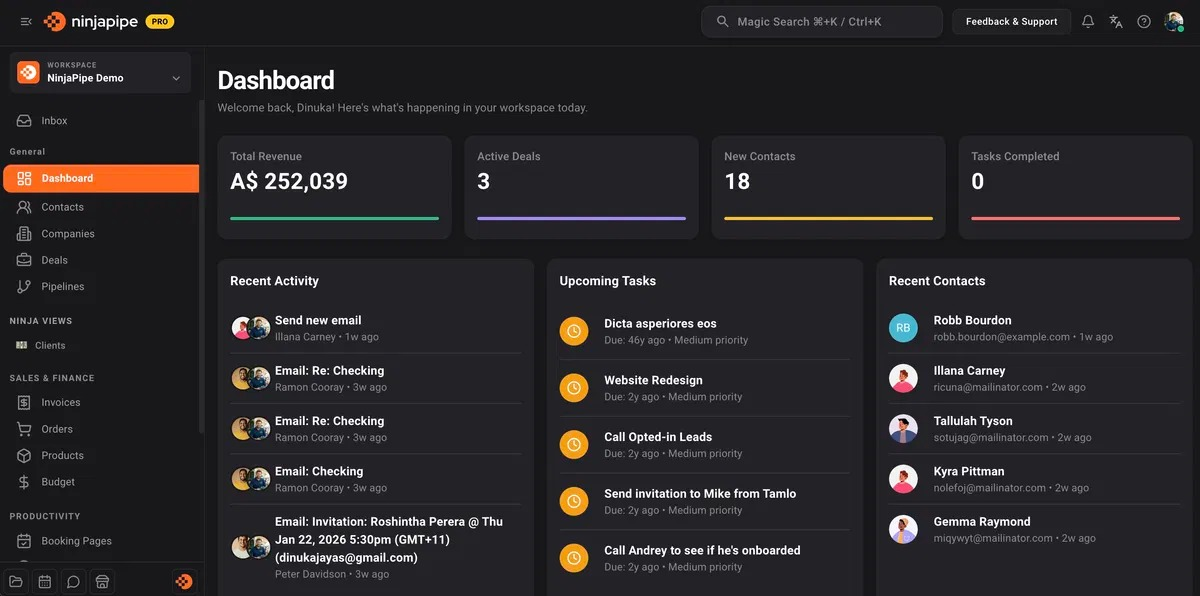
The CRM overhead problem for small teams
Enterprise CRMs are powerful because they can model almost anything. That same flexibility can create a second job: configuring objects, maintaining fields, connecting add-ons, and asking the team to update a system that feels separate from the work itself.
For a small sales team, freelancer, agency, or growing service business, the important loop is usually more direct: capture a lead, qualify the opportunity, follow up at the right time, send the proposal, and know what is waiting on whom. The software should make that loop easier to run, not turn it into an implementation project.
What NinjaPipe brings together
The centre of the product is the CRM, but the pitch is broader than a kanban board. NinjaPipe connects the surfaces that turn a lead into a customer and keep the relationship moving after the first sale.
- Sales pipelines for seeing stages, bottlenecks, owners, and deal value in one glance.
- Unified inbox, WhatsApp, and SMS conversations so context stays close to the opportunity.
- Forms, booking pages, invoices, quotes, and client portals that turn interest into a next step.
- Documents, subscriptions, mobile apps, and API integrations for the work after the deal is won.
A CRM becomes useful when it answers the next-action question faster than a founder can reconstruct the story from memory.
The pipeline as an operating system
A pipeline is more than a visual sales report. It is a shared agreement about where an opportunity is, what evidence moves it forward, and which person owns the next action. The simpler that agreement is to maintain, the more likely it is to stay accurate.
NinjaPipe leans into that operational view. Teams can visualize the full process, drag deals across stages, and spot stalled work without digging through separate records. That makes the pipeline useful in a Monday review, a daily stand-up, or a quick check from a phone between meetings.
Customization without enterprise drag
No two businesses qualify, sell, and onboard customers in exactly the same way. NinjaPipe addresses that difference with custom fields, sections, and views, so a team can shape the records around its actual sales motion instead of forcing every relationship into a generic template.
The distinction is important: customization should clarify the workflow, not become the workflow. For a small team, the best fields are the ones that help someone decide, follow up, or hand work to the next person.
Workflows that keep deals moving
Manual follow-up is one of the first cracks to appear in a growing sales process. A lead arrives after a busy day, a proposal needs a reminder, or a booking changes and the update never reaches the rest of the team. NinjaPipe uses workflow automation to turn those rules into repeatable actions.
The practical value is not automation for its own sake. It is making sure that known events, such as a form submission, stage change, booked call, or signed document, reliably produce the next useful step while keeping the human in control of the relationship.
- 1Capture the signal through a form, inbox, booking page, or connected channel.
- 2Route it into the right pipeline, record, owner, and follow-up sequence.
- 3Keep the human conversation visible while the system handles predictable reminders and updates.
Beyond the pipeline: the connected sales workspace
NinjaPipe expands into the practical edges of a sales operation: booking pages for confirmed meetings, forms for capturing demand, invoices and quotes for commercial follow-through, and Ninja DocSign for collecting signatures. It also includes whiteboards and collaboration tools for teams that need to plan the work around the deal.
That breadth makes the product feel less like a database of contacts and more like a small business operating layer. The fit depends on whether a team wants one environment to connect marketing signals, sales execution, and customer handoff instead of assembling each piece independently.
Who NinjaPipe fits best
NinjaPipe is aimed at small to mid-sized sales teams, freelancers, agencies, consultants, coaches, and growing businesses that want a full sales workflow without the setup burden of a heavyweight CRM. Its mobile and desktop coverage also makes sense for teams that sell away from a desk.
It is a better fit when the business needs a connected process around leads and deals. If a team only needs a lightweight contact list, or already has a deeply specialized enterprise stack, the breadth may be more than necessary. The product earns its place when the cost of disconnected tools is higher than the cost of learning one shared workspace.
Why Indie Chains recommends NinjaPipe
Indie Chains editorial
NinjaPipe is a strong fit for founders and small teams who want sales software to disappear into the work instead of becoming another system to administer. The product connects the pipeline with the moments around it: a lead arrives, a meeting gets booked, a proposal is sent, a document is signed, and the next action is still visible.
We like the emphasis on practical momentum. The value is not that NinjaPipe has a long feature list; it is that the feature list is organized around keeping a real sales process moving for teams that do not have time to manage a CRM as a separate discipline.
Visit NinjaPipeRelated showcase
Other entries in the Showcase network worth exploring.
Timestream: A Local-First Git Client Built Around the Commit Graph
How Timestream turns Git history into a visual timeline, then connects diff review, commits, SSH pushes, and GitHub pull requests in one desktop desk.
8 min read
Read
OutReign: From Plain-English ICP to a Live B2B Outbound Workflow
How OutReign turns an ideal customer description into ranked prospects, SMTP-verified emails, personalized first-touch drafts, and a repeatable outbound workflow.
8 min read
Read