Replace the dead link, preserve the reason
Broken Link Building: How to Find and Replace Dead Links
A practical way to find dead external links, preserve the original citation’s purpose, and make a replacement suggestion a publisher can evaluate.
The short answer
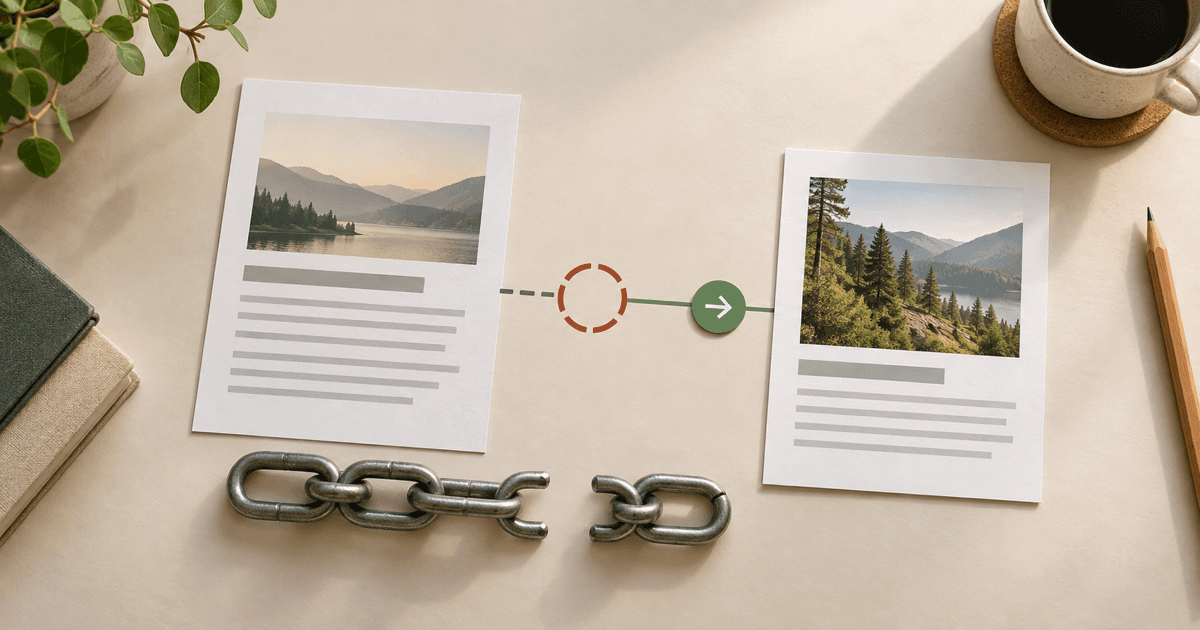
Broken link building means finding a dead external link on a relevant publisher page and offering a live resource that preserves the original link’s purpose.
The value exchange is practical: the publisher can improve a page, the reader can reach a working reference, and your resource can be considered. None of that gives you an entitlement to a link or a ranking outcome.
Replacement equivalence is the central test
The weak version of broken link building asks, “Can I put my URL where the dead URL was?” The useful version asks, “What job did the original reference do for this reader, and does my page preserve that job?” That shift protects the publisher from a low-quality substitution and protects you from pitching a page that does not belong.
Equivalence does not require copying the old page or reproducing its wording. It means matching the meaningful parts of the citation: the audience, task, scope, evidence, and expected next click. When the old purpose cannot be established, the responsible result may be a notification without a pitch or no action at all.
| Check | Question about the dead link | What equivalence looks like |
|---|---|---|
| Original purpose | What did the dead link help the reader do: learn, compare, calculate, implement, verify, or find a source? | Your page should serve the same reader task, not merely mention the same topic. |
| Audience | Who was the source page written for, and who would have clicked the original link? | A resource for enterprise procurement is not automatically equivalent to a founder checklist. |
| Scope and depth | Was the original a short definition, a detailed guide, a dataset, a tool, or documentation? | A homepage or thin sales page is rarely equivalent to a specific reference resource. |
| Evidence and freshness | Did the old resource support a claim, provide current instructions, or document a version-specific task? | Preserve the useful evidence and update what has changed; do not recreate outdated instructions without a note. |
| Reader expectation | What would a reader reasonably expect after clicking the anchor? | The replacement should make the next click feel unsurprising and useful. |
Do not confuse it with reclamation
These methods can look similar because each starts with a link or mention that needs attention. The starting ownership is different, so the right next action is different too.
Broken link building
A relevant publisher page contains a dead external link. You find the broken destination and offer a live resource that preserves the original citation’s purpose.
Link reclamation
A link or mention that you already earned changed, disappeared, or points to the wrong destination. The task is to recover your own recognition, not replace somebody else’s dead reference.
Unlinked brand mention reclamation
A publisher names your company, product, founder, or research without linking. You can make a respectful request, but the mention is not an entitlement to a link.
Redirecting your own broken backlinks
A source still links to your old URL, but your destination moved. Fix the destination or redirect it when appropriate; do not present that maintenance task as broken link building.
If the problem is a mention or link you already earned, use the link reclamation guide. This article is for a dead third-party reference that you did not own.
A complete broken link building workflow
Treat the workflow as research and maintenance, not as a license to send a message every time a URL returns an error.
- 01
Choose a relevant topic or resource-page footprint
Start with a topic your product, research, template, documentation, or guide genuinely supports. Resource pages, tutorials, partner documentation, and citations are useful footprints because the original link usually had a visible job. Do not begin with a list of random 404 URLs.
- 02
Find pages containing dead external links
Search for relevant resource pages and inspect their outbound links with a browser, crawler, or backlink tool. A tool can surface candidates, but the exact source page is the unit you must review. A “broken backlink” here means a publisher’s outbound link that no longer reaches its intended destination—not a lost link to your own site.
- 03
Confirm the destination is actually unavailable
Open the URL directly, check the response more than once when a timeout or server error is involved, and follow redirects. A temporary failure is not the same as a dead resource. A redirect to an unrelated page, a parked domain, or an unsafe destination may be a quality problem, but it is not automatically a replacement opportunity.
- 04
Inspect the historical resource when possible
Use an archive such as the Internet Archive’s Wayback Machine to understand what the old page covered, who it served, and whether the citation was a guide, data source, definition, tool, or documentation reference. Historical context helps you preserve the original purpose instead of guessing from a URL slug.
- 05
Apply the replacement-equivalence test
Compare the old resource’s job with your proposed destination. Check the audience, claim or task, scope, depth, format, and freshness. If your page only shares a keyword or category, it is not an equivalent replacement. Report the dead link without pitching, or discard the opportunity.
- 06
Improve or create the replacement when necessary
An existing page can be a good replacement if it already answers the same question. If it is close but incomplete, improve it before contacting the publisher. Create a new resource only when the missing page would be useful on its own; never recreate a thin version of the old page just to obtain its URL slot.
- 07
Contact the publisher with exact context
Name the source page, identify the dead link or section, explain what the original resource appeared to do, and offer your URL only if it is genuinely relevant. The publisher should be able to verify the issue and decide whether your suggestion belongs. The link-building outreach guide covers the communication boundary in more detail.
- 08
Track the response and verify the result
Record the source URL, old destination, proposed replacement, date contacted, response, and final state. If a link is added, verify the exact page, destination, redirect behavior, context, and attributes. The backlink monitoring checklist covers the post-placement check.
What should you recommend?
A dead link does not always justify a pitch. Use the evidence from the source page and historical resource to choose the smallest honest next action.
| Observed situation | Recommendation | Reason |
|---|---|---|
| Your existing page answers the same task at a similar depth | Recommend the existing page | Explain the equivalence briefly and let the publisher decide whether it improves the source page. |
| The old resource had a clear job, but your current pages do not do it | Create a new resource first | Build the page for the audience before contacting anyone. If it is not useful without the pitch, it is not ready. |
| The dead URL is real, but the historical purpose is unclear or the page is low-risk to fix directly | Report the issue without pitching | A publisher-first notification can improve the page without turning every error into an acquisition request. |
| The source is unrelated, unsafe, abandoned, noindex, manipulative, or impossible to match honestly | Discard the opportunity | A dead link is not a license to force a commercial page into an unrelated article. |
If the replacement is relevant but the placement itself needs paragraph-level judgment, use the contextual backlinks guide. It helps you test whether the source passage and destination make sense together.
Before you invest time in a pitch, run the candidate through the backlink quality checklist. When the opportunity survives that review, use the link-building outreach guide for a concise, publisher-first message.
Two concise outreach templates
These templates are starting points, not mail-merge copy. Replace every bracket with evidence from the exact page, and do not imply a relationship or familiarity that does not exist.
1. Publisher-first broken-link notification
Subject: Possible broken link on [page title]

Hi [name],

I was reading [exact page URL] while researching [topic]. The link in [section or anchor text] currently leads to [error, unavailable destination, or unrelated redirect].

I thought you would want to know so you can decide whether to update or remove it. No replacement request attached—just passing along the issue.

Best,
[name]
2. Notification with a relevant replacement
Subject: Broken reference on [page title] + possible replacement

Hi [name],

I noticed that [exact page URL] links from [section or anchor text] to [dead destination]. The archived version appears to have helped readers with [original purpose].

I maintain [replacement URL], which covers [specific equivalent task] for [audience]. It may be a useful replacement, but please use whatever source best fits the page—or remove the link if that is cleaner.

Thanks for keeping the guide useful,
[name]
A publisher can decline, choose another source, repair the original, or make no change. If your message would feel unreasonable without the promise of a backlink, the replacement is probably not strong enough.
Illustrative example: preserving a citation’s job
This example uses fictional domains and is only meant to show the reasoning.
Suppose founderops.example maintains a guide called “Vendor onboarding for a small SaaS team.” In its checklist section, a link to oldmetrics.example/setup is dead. The Wayback Machine shows that the old page explained how to define handoff fields before a vendor goes live. ledgerloop.example has an existing public checklist that explains the same handoff task, with comparable depth and a current example. That is a candidate for a careful suggestion because the replacement preserves the citation’s job. If LedgerLoop only had a product homepage, it should either improve the resource first or send no pitch. If the source page were abandoned or unrelated, the correct action would be to discard the opportunity.
Quality and risk checks
A dead link is a signal to investigate, not proof that the source page wants a replacement. Use these checks before contacting anyone.
Topical mismatch
Signal: The source and replacement share a word but not an audience, task, or editorial reason.
Response: Do not pitch. Find a better footprint or improve the resource’s actual usefulness.
Recreated thin content
Signal: A shallow page is produced only to imitate the dead URL or capture its link location.
Response: Build a complete resource that stands on its own, or discard the candidate.
Abandoned website
Signal: The domain has no accountable publisher, broken navigation, stale pages, or a pattern of expired content.
Response: Treat it as maintenance noise, not as a promising editorial relationship.
Unsafe domain
Signal: The old destination or source shows malware, deceptive behavior, adult or illegal content unrelated to the page, or a suspicious parked domain.
Response: Do not click further than necessary, do not reproduce the destination, and discard the opportunity.
Redirect chain
Signal: The old URL passes through several redirects, ends at an unrelated page, or no longer preserves the original purpose.
Response: Check the final destination and historical context. A redirect alone does not prove a replacement need.
Noindex or inaccessible replacement
Signal: Your proposed page is blocked from indexing, requires a login, or cannot be reached by the source page’s ordinary reader.
Response: Use a public, maintained destination when the source page is meant to serve public readers.
Scaled outreach
Signal: The same message is sent to many sites without checking the exact dead link, historical purpose, or audience.
Response: Keep the list small, personalize the evidence, and stop when the editorial reason is absent.
Google’s spam policies warn against links created primarily to manipulate rankings, including scaled or manipulative patterns. Broken link building is only defensible when the replacement is useful independently of the request and the publisher keeps editorial control.
Broken link building checklist
Before sending a broken link outreach message, confirm:
- The source page serves the same audience your replacement is meant to help.
- The original external link is actually unavailable, not merely slow once.
- You recorded the exact source URL, dead destination, anchor, and surrounding section.
- You checked the historical resource when the original purpose was not obvious.
- Your replacement preserves the original citation’s purpose, scope, and expected reader task.
- The destination is public, maintained, safe, crawlable, and not just a weak commercial homepage.
- You have chosen between an existing page, a new resource, a notification without a pitch, or no action.
- Your message gives the publisher enough evidence to verify the issue without claiming familiarity you do not have.
- You accept that the publisher may fix the link, choose another resource, add no link, or not respond.
- If the link goes live, you record and verify it later instead of treating publication as permanent.
After publication, review the source page with the backlink monitoring checklist. A link that goes live is a new state to verify, not the end of the workflow.
Where Indie Chains fits
Indie Chains can help founders discover relevant publisher conversations, but it does not sell dead-link replacements, guarantee a placement, or decide what another site should publish. The publisher keeps control of the page, wording, destination, disclosure, and link attributes.
When you have a replacement that passes the equivalence test, the backlink exchange platform can be one place to discover relevant conversations. Bring the exact source page and reader benefit to the discussion; do not bring a demand for a link.
Questions founders ask
What is broken link building?
Broken link building is finding a dead external link on a relevant publisher page and suggesting a live resource that preserves the original link’s purpose. The publisher gets a page that is easier to maintain, the reader gets a working reference, and you get an opportunity to be considered—not a guaranteed link.
How do I find broken backlinks?
Start with relevant resource pages, tutorials, documentation, and citation footprints. Inspect outbound links with a browser, crawler, or backlink tool, then confirm the exact destination is unavailable and review the surrounding context. In this guide, “broken backlink” means a dead outbound link on the publisher’s page, not a backlink you previously earned.
Is broken link building the same as link reclamation?
No. Broken link building starts with another publisher’s dead external reference. Link reclamation starts with recognition you already earned, such as a lost backlink, changed URL, or unlinked brand mention. Use the link reclamation guide for that separate workflow.
What makes a good broken-link replacement?
A good replacement preserves the old link’s job for the source page’s reader. It matches the topic, audience, task, scope, depth, and expected click, while remaining current, public, safe, and useful on its own. A related homepage or thin page is not equivalent just because it uses similar words.
Is broken link outreach spam?
It can become spam when it is automated, scaled, deceptive, unrelated, or built around weak replacement pages. A small, evidence-based notification that respects the publisher’s editorial control is a different practice. You should be comfortable with the publisher choosing no link, another resource, or no response.
Sources
Google’s documentation is the primary source for crawlable links, outbound-link qualification, people-first content, and spam-policy claims. The historical-resource step points to the Internet Archive as a practical research source; archived content still needs independent judgment.
Do not replace a dead link with your page. Replace the job the dead link used to do.
Check the exact context, build the equivalent resource, and let the publisher choose. If you want to discover relevant conversations after that, start with the Indie Chains platform.